Finding Your Google Workspace Add-on Niche (My Research Framework)
The exact process I use to discover untapped opportunities in the Google Workspace Marketplace before writing a single line of code.

After building several add-ons and talking to dozens of developers, I've noticed a pattern: the ones who struggle aren't lacking technical skills—they picked the wrong niche.
I get it. When you have an idea, you want to start coding immediately. But spending a weekend on research can save you months of wasted effort.
Here's the framework I use before committing to any new add-on project.
The Positioning Problem
Let me be direct: if your plan is to build "a better spreadsheet tool" or "another form builder," you're setting yourself up for a tough fight.
The marketplace already has established players with thousands of installs, years of reviews, and SEO momentum. Going head-to-head with them is possible, but it's the hard path.
My approach: find the gap they're not serving.
Think of it as finding a smaller pond where you can actually be noticed. Specific problems for specific users beats generic solutions for everyone.
My 4-Step Research Process
I've refined this over multiple projects. It takes about a day of focused work and uses entirely free tools.
Step 1: Validate Interest with Google Trends
Before anything else, I check if people are actually searching for solutions to this problem.
Head to Google Trends and enter your base keyword. I'm looking for two things:
- Stable or growing interest - A declining trend is a red flag
- Related queries - These often reveal angles I hadn't considered
The "Related queries" section is gold. Toggle between "Rising" (what's gaining momentum) and "Top" (established demand). I usually find 3-4 interesting variations I hadn't thought of.
Pro tip: filter by region if you're targeting specific markets. Demand can vary significantly by country.
Step 2: Expand with Long-Tail Keywords
Next, I use Keyword.io to generate variations. This free tool pulls suggestions from Google, YouTube, Amazon, and other sources.
Why does this matter? Long-tail keywords reveal specific user intents. "QR code generator" is broad. "QR code generator for Google Slides presentations" is a niche.
I dump my base keyword in and scan the results for patterns. Which variations mention specific Google apps? Which ones reference particular use cases or industries?
I usually end up with a shortlist of 10-15 promising variations to investigate further.
Step 3: Quantify Demand with Keyword Planner
Now I need actual numbers. Google Ads Keyword Planner gives you monthly search volume data for free (you need a Google Ads account, but don't need to run any campaigns).
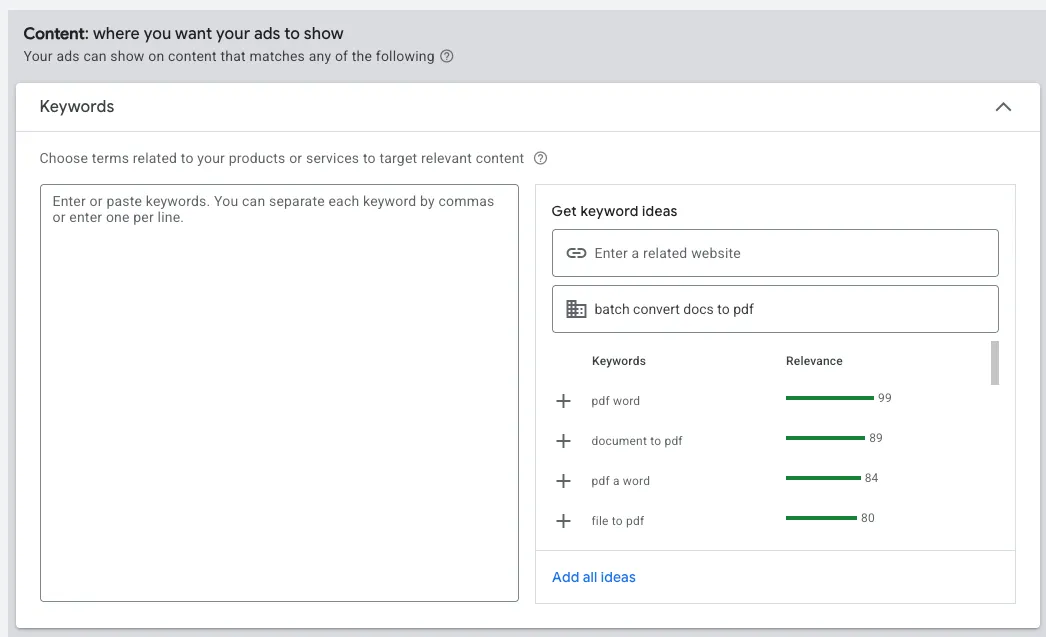
What I'm looking for:
- Relevance for keywords
What I avoid:
- High competition keywords (saturated)
- Under 100 searches/month (might not be enough demand)
Step 4: Scout the Actual Marketplace
This is where most developers skip ahead, but doing it last gives you context for what you're seeing.
Go to the Google Workspace Marketplace and search your target keywords.
I'm answering these questions:
- How many add-ons currently serve this need?
- What do their install counts look like?
- What are users complaining about in reviews?
- Are there specific Google apps with no coverage?
The signal I'm hunting for:
- Few or no results for a keyword with validated demand
- Existing add-ons with poor ratings (under 4 stars)
- Stale add-ons that haven't been updated in over a year
- Reviews explicitly requesting features that don't exist
When I find a keyword with decent search volume but weak marketplace coverage, that's my opportunity.
Going Deeper: Secondary Validation
The four steps above give me a solid foundation, but for ideas I'm seriously considering, I do additional validation.
Check adjacent platforms. Does this problem exist in the Microsoft ecosystem too? What about Notion or Airtable? If users on multiple platforms need this, it validates the underlying demand.
Read competitor reviews obsessively. I go through 1-star to 3-star reviews on competing add-ons. Users literally tell you what's broken or missing. This is free market research.
Lurk in communities. Reddit (r/GoogleWorkspace, r/gsuite), Twitter, and various Slack communities surface pain points that never make it to formal feedback channels.
Consider monetization from day one. Can users justify paying for this? Is it a "nice to have" or a "need to have"? I've seen technically excellent add-ons fail because they solved problems people wouldn't pay to fix.
Mistakes I've Made (So You Don't Have To)
Building what I wanted, not what users needed. Early on, I built tools that solved my own problems without validating that others shared them. Some of these went nowhere.
Targeting niches that were too narrow. There's a balance. "Invoice generator for Google Docs" is good. "Invoice generator for freelance dog photographers" is probably too specific.
From Research to Execution
Once I've validated a niche, here's my typical sequence:
- Scope the MVP ruthlessly - What's the minimum feature set that delivers value?
- Build with monetization in mind - Even if you launch free, know how you'll eventually charge
- Optimize your listing - Use your researched keywords in the title, description, and screenshots. Read more in How I Market Google Workspace Add-ons (A Complete Playbook)
- Track users usage - It will depend a lot on the type of addon and market, from audit logs up to talking with most engaged users, try to undestand what your users are doing, what is working and what it is not.
The research phase feels slow when you're eager to build, but it's an investment that pays off.
Wrapping Up
Finding the right niche isn't about having a revolutionary idea. It's about finding the intersection of genuine demand, weak existing solutions, and your ability to deliver something better.
The Google Workspace ecosystem keeps growing as more organizations adopt these tools. That means new opportunities keep emerging—gaps that didn't exist a year ago might be wide open today.
If you're building add-ons with ShipAddons, the niche research is still on you. But once you've found your opportunity, ShipAddons handles the infrastructure so you can focus on the product.
The developers who succeed in this space aren't always the most talented. They're the ones who took the time to find the right problem before jumping into code.